TPI / CPI
Kroftas Tilted Plate Interceptor (TPI) is used for oil-water separation in wastewater treatment and industrial applications. TPIs are designed to efficiently remove free floating oil from water by employing a combination of gravity separation and coalescence. Krofta started manufacturing TPIs after a technical collaboration with Stetfield Separators.
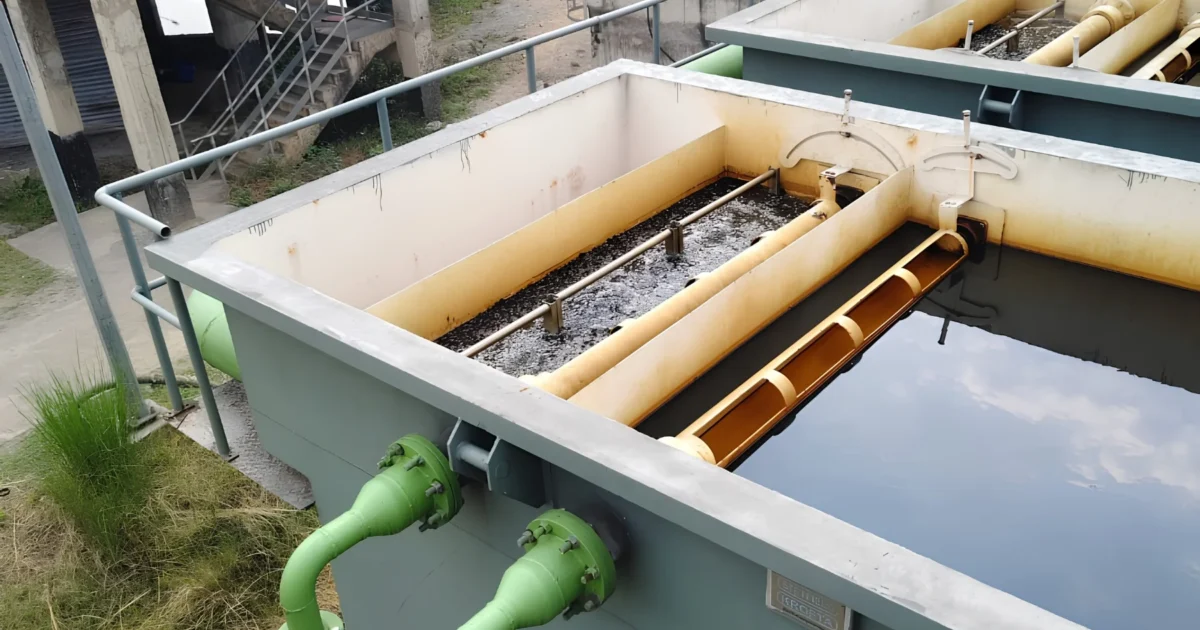
The TPI operates based on the principles of gravity settling and coalescence, leveraging inclined plates within a compact unit. These plates are positioned at an angle, usually between 45 to 60 degrees, allowing for the formation of a larger surface area where oil droplets and solid particles can interact and separate from the water. The Corrugated Plate Interceptor (CPI) performs the same function however, instead of plates, there is a corrugated plate pack inside of the main tank. TPI/CPI units can be manufactured in a completely metallic tank, with protective coatings, or in a civil tank with wetted metallic parts.
Key features and components:
Inclined Plates
The inclined plates are the central component of the TPI. They provide a surface for the oil droplets and suspended solids to adhere to and coalesce, becoming larger and easier to separate from the water.
Separation and Coalescence
As the wastewater flows through the inclined plates, the oil droplets and suspended solids collide, forming larger particles that rise to the surface.
Outlet Section
Clarified water is collected from the lower portion of the TPI and is discharged for further treatment or environmental release.
Separation Capacities & Efficiency Performance
- The single stage TPI is used to remove Oil globule sizes of 50 micron or higher, while the two stage TPI is used to remove oil globules of 20 microns and above.
- Krofta TPI can remove up to 99% of free-floating oil from the waste water.
After this process, the waste water is usually taken for dissolved air flotation (DAF) treatment to remove suspended solids and emulsified oil.
Advantages
Compact Footprint
Compact design and very small footprint
Scalable Engineering
Can be constructed in a fully metallic structure or in a civil tank with metallic internal parts. There is no bar on the maximum flow a single unit can treat.
Zero Maintenance
Zero maintenance machine since there is no power or chemical consumption after installation
High Oil Separation
Highly efficient in removing free floating oil
Popular Applications
Oil Refineries
Petrochemical Plants
Power Plants
Automotive Paint Shops
API Solutions